Last verified: August 2026.
The most private way to use AI is to run it locally on your own computer.
Providers like BrainDrive, Open WebUI, and LM Studio are designed to make this easy for anyone. Once you download a model, you can run your AI system without even needing an internet connection.
What you trade for the privacy offered via local AI models is capability.
Models that you can run on a personal computer are generally not as capable as the models you use in systems like ChatGPT or Claude. And you need a machine that can run them.
If local is not enough for your task, you need a cloud model. And sending your prompts to a cloud based AI model doesn’t necessarily mean giving up your privacy.
Privacy focused providers like Venice, DuckDuckGo, Proton, and others offer more protection than ChatGPT’s defaults. They do this either via a hardware privacy guarantee called a trusted execution environment (TEE), a contract that legally requires them to maintain your privacy, and/or a stated policy for how they handle your data.
These cloud providers are where all the privacy nuance is, and where most of this guide is therefore focused.
Short answer: Want a pick today? Duck.ai is free, needs no account, and its two models labeled ‘zero provider visibility’ run in a hardware enclave; Maple AI is the strongest default if you don’t mind signing up. The most private AI is a local model: BrainDrive, Open WebUI, or LM Studio, with network features off. For cloud AI, Maple, Venice TEE/E2EE, and those two Duck.ai models are hardware-verifiable: the company running the server cannot read your prompt. Lumo, Brave Leo, Kagi, Mistral Vibe, and Duck.ai’s other models rely on contracts or policies. As of August 2026.
Prefer to watch? This guide has a companion video: What Is the Most Private AI? (under 5 minutes).
Four Terms You Need to Compare Them
Every chatbot works the same basic way: you send a message, a model reads it on your own or someone else’s cloud based computer, and it sends an answer back. “Private” describes who else can read that message and what prevents them from doing so. Reviews of the best AI for privacy usually rank products by a score. This page ranks them by mechanism, because that is what decides who can read your message.
To know how private an AI system is, answer these three questions:
- Does the service keep your messages? That is retention.
- Can anyone look at them? That includes human review and operator access.
- Does the model learn from them? That is training.
“We don’t train on your data” says nothing about retention. “Deleted after 30 days” says nothing about access. The four terms below explain what backs each promise, from most private to least.
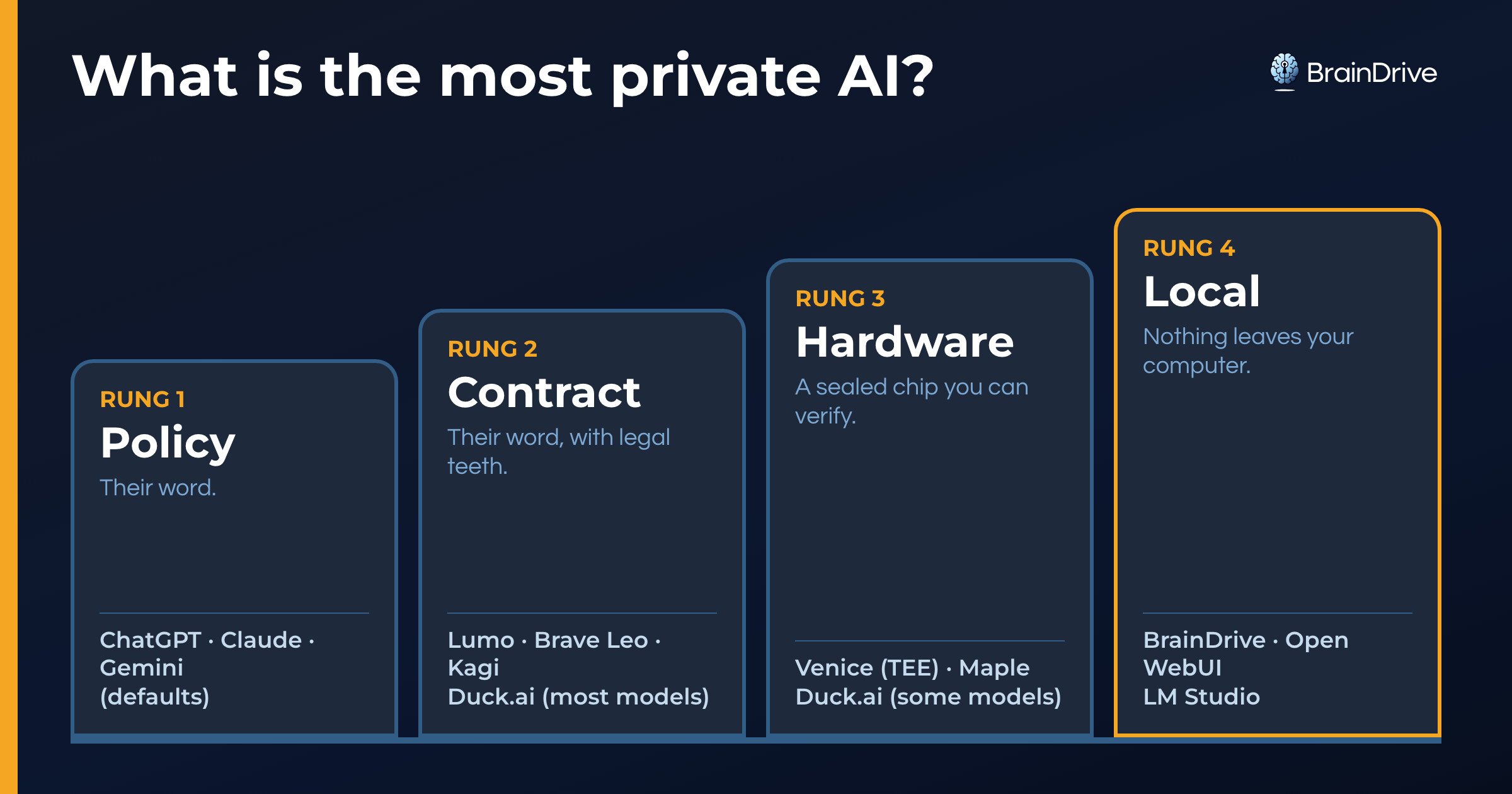
Local. The model runs on your computer, so nobody else receives your message. You can verify this by turning off Wi-Fi. Turning your Wi-Fi on and using things like web search, plugins, and cloud fallback break that boundary.
TEE (trusted execution environment). The most private cloud option. The model runs inside a hardware-isolated enclave that the server operator cannot inspect. The model still has to read your message in plain text in order to provide a response, but the operator cannot read the model’s memory. (That working moment is what the industry calls inference.)
Remote attestation provides a certificate showing that genuine hardware runs a specific program. It does not prove the program is honest. Open-source providers let reviewers compare that program with the certificate’s hash. Trust moves to the chip maker and inspectable code; it does not disappear.
Some providers also encrypt messages from your device to the enclave. Venice calls this end-to-end encryption (E2EE), and Maple does it by default. If the company’s ordinary server decrypts the message, that is encryption in transit, not E2EE. The tradeoffs are slower inference and fewer models. NVIDIA reports typically under 8% overhead, Tinfoil reports under 10%, and independent tests have found more on untuned systems.
Contract. The service has a signed agreement with whoever runs the model: no keeping, no training. Their word, with legal teeth. This gives a privacy promise legal force, and is therefore the next most private option behind hardware guaranteed TEEs.
Keep in mind here however that the service provider is not always the same as the company that runs the AI models used in that service. Kagi and Duck.ai, for example, can send prompts to models run by Anthropic or OpenAI.
So when evaluating a service make sure you understand who is providing the model you are using in that service and how this affects your privacy.
Policy. The weakest form of privacy guarantee. The company publishes what it does with your chats. There is no hardware guarantee or upstream contract, only a policy the company can later change.
Our full AI privacy guide uses a six-position dial from default consumer apps to fully local AI. This article covers its private half. Contract and hardware providers often sound alike, but only hardware keeps the prompt unreadable to the operator during inference.
Start Here: Local is the most private option
Choose local whenever a home-sized model can do the job. BrainDrive, OpenWebUI, and LM Studio can keep inference on your computer. Home-sized means roughly an 8–30 billion parameter model on a machine with 16 GB of memory. Our local AI guide covers setup; this companion checks your hardware.
The Most Private Cloud AI Chatbots (Hardware-Verified)
These cloud services keep prompts hidden from the enclave operator and, for Venice and Maple, provide a certificate you can verify. Duck.ai’s Tinfoil models carry Tinfoil’s attestation, which DuckDuckGo does not expose in its own docs. Three limits apply as of August 2026:
- The certificate does not hide your identity.
- It protects only data that stays inside the enclave. Uploads and web search may leave it.
- These services offer open-weight models, not GPT or Claude.
| Pick | Free tier | Account? |
|---|---|---|
| Duck.ai (Tinfoil models) | Free | None |
| Venice (TEE / E2EE) | Free, 10 prompts a day | Optional, with limits |
| Maple AI | Free, 25 messages a week | Email signup |
Venice, in TEE or E2EE mode (Venice docs). NEAR AI Cloud and Phala Network operate the enclaves. You can validate their attestation outside Venice. In E2EE mode, Venice passes your message along in scrambled form, and only the enclave holds the key to unscramble it. History stays in your browser, but Venice keeps account or wallet identifiers, timestamps, model choice, token counts, and your IP (privacy policy). E2EE is text-only and disables web search, uploads, memory, and function calling. Also: about a dozen open-weight models in these modes as of August 2026, including gpt-oss-120b, Gemma 4 31B, GLM 5.2, and DeepSeek V4 Flash; they carry an “e2ee-” prefix in the model list, which changes often. API access. Cost: Free, 10 text prompts a day; Pro $18/mo (pricing).
Duck.ai, on its two Tinfoil models (Duck.ai privacy). DuckDuckGo removes your IP before sending the request. Tinfoil runs gpt-oss-120b and Gemma 4 31B in a TEE, so Tinfoil cannot read prompts or responses. Uploads still go to a third-party moderation service outside the encrypted channel. DuckDuckGo does not say whether its own relay server, the one that strips your IP, can read the message on the way through. Also: no account, on-device history, optional encrypted sync, and Claude or GPT in the same app. Cost: Free.
Maple AI (OpenSecret). Your client encrypts each message. An AWS Nitro Enclave holds the keys and re-encrypts the data for inference inside a GPU TEE (technicals). Maple combines default encryption, verifiable attestation, and open-source enclave code tied to a published hash. You sign up with an email, and payment can identify a paid account. Maple says your conversations stay private ‘even from us’; each user has a private key Maple manages inside the enclave. Also: GPT-OSS, Gemma 4 31B, GLM 5.2, Kimi K2.6. Web search requires a paid plan, and Maple accepts Bitcoin. Cost: Free, 25 messages a week; Pro $20/mo (pricing).
Tinfoil Chat and Privatemode use similar enclave designs. Tinfoil clearly lists what legal process can reach: metadata and ciphertext it cannot decrypt.
And who you are. An enclave protects what you say, not who asks. Brave Leo requires no account and says it collects no linked identifiers such as IP addresses, though its stable models rely on contracts. Duck.ai also needs no account and strips your IP. Venice permits account-free chat but logs your IP; a crypto wallet can replace email. Lumo offers guest access over Tor. Maple requires an account but accepts Bitcoin. Your remaining network identity is a VPN or Tor question, not a chatbot setting.
Popular in Privacy Searches, but Not Hardware-Verified
These privacy-focused AI chatbots rely mainly on contracts and policies rather than hardware. Their servers, or an upstream provider’s servers, can read the message during inference. Some promise no retention or training; others require an opt-out. As of August 2026:
- Proton Lumo (privacy). No training or logs; saved history is zero-access encrypted. But Proton calls its design “User-to-Lumo encryption”: its GPU server decrypts the prompt. Proton says it stores no metadata such as timestamps or IP addresses, but there is no TEE. Models include Qwen 3.5 and GLM 5.2. Plus costs $12.99/month.
- Brave Leo (Brave). No account or linked identifiers; chats are not retained for training. Brave removes identifiers before routing among Claude, Llama, and Mistral variants. One hardware-enclave model is available only in the Nightly build. Free.
- Kagi Assistant (Kagi). Neither Kagi nor its providers train on chats. Kagi also publishes upstream retention: Claude and OpenAI 30 days, Gemini 24 hours, and selected Nebius-hosted models not stored. Paid subscription only.
- Mistral Vibe, formerly Le Chat (Mistral). Free, Pro, and Education use inputs and outputs for training by default unless you opt out. Only Team and Enterprise exclude training by default. Having an opt-out is not the same as being opted out.
- Duck.ai, on its other models (terms). DuckDuckGo strips your IP and has no-training agreements with Anthropic, OpenAI, Mistral, and Azure. The stated 30 days is a ceiling; actual retention is none or an in-memory cache of up to one hour. Free; Plus costs $9.99/month.
- Venice, in Anonymous or Private mode (privacy). Private mode promises zero retention on Venice-controlled GPUs. Anonymous mode proxies to outside providers that may save your prompt. As of August 2026, GPT, Claude, and Gemini are reachable only through Anonymous mode.
For Claude or GPT, Kagi states 30-day upstream retention. Duck.ai promises zero retention but allows up to one hour of in-memory caching. Both remain trust-based.
The Baseline
The mainstream baseline looks like this:
- ChatGPT clears deleted chats within 30 days, allows human review, and trains unless you opt out. Its $8 Go tier “may include ads.”
- Claude clears deleted chats within 30 days. With training on, de-identified copies can remain in training pipelines for five years. Its docs do not say whether training is on by default, or whether staff ever review chats.
- Gemini keeps activity for 18 months, reviews a subset of chats, and trains when Keep Activity is on.
You can change each in five minutes: Is ChatGPT Private?
Three Phrases That Sound Like Guarantees
- “No logs.” Usually means chat content is not stored. It says nothing about metadata, in-memory access, upstream providers, or legal orders.
- “End-to-end encrypted.” Ask what decrypts the message: an ordinary server, as with Lumo, or an enclave, as with Maple and Venice E2EE. Encrypted history is separate.
- “30 days.” This is often a ceiling, not actual storage time. Duck.ai’s disclosed figures are zero or one hour.
So Which One?
Set privacy per task:
- Free and no account: Duck.ai’s Tinfoil models.
- Paying for the strongest default, or for sensitive health, financial, or family information: Maple.
- Need Claude or GPT: Kagi (30-day upstream retention) or Duck.ai (up to an hour of in-memory caching), on their word.
- Already on ChatGPT, Claude, or Gemini: training off and Temporary or Incognito chat for low-risk work.
- Local when a home-sized model is enough, with network features off.
Your organization decides how to handle confidential workplace data; our full guide explains when law or policy sets the limit. Never put passwords, recovery codes, account numbers, government IDs, or someone else’s private information in a prompt. The best privacy control is the sentence you did not type.
One Interface, Every Option
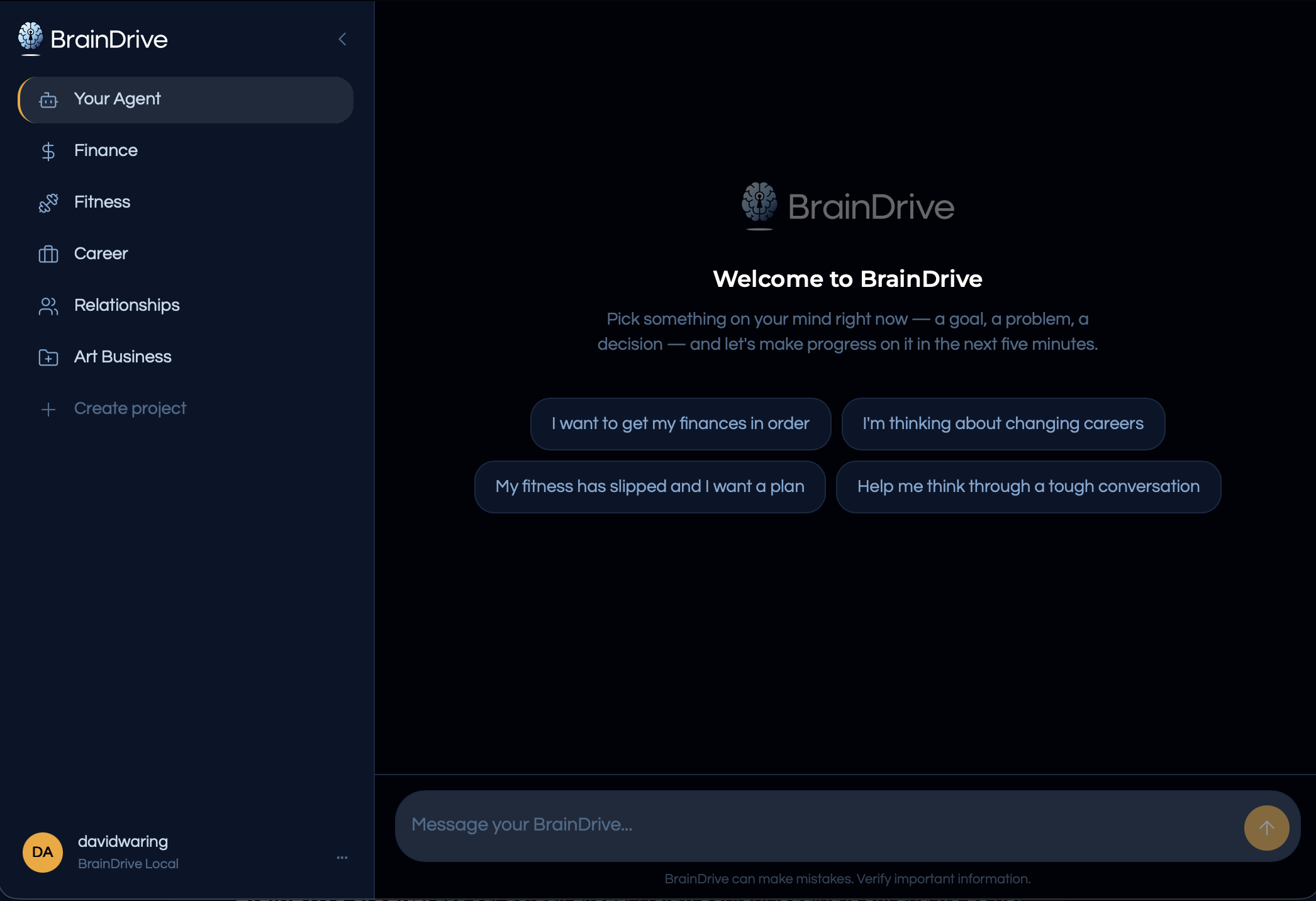
Following this list can mean juggling several apps. BrainDrive provides one open-source interface where you keep your history and memory, then switch backends. I am building it, so read this section as a vendor talking.
BrainDrive has three backends today:
- Ollama: run a local model so nothing leaves your machine, with the same network-feature caveat as above.
- OpenRouter: bring your OpenRouter key and route requests through it to a separate model provider. OpenRouter lets you choose that provider, require zero-data-retention (ZDR) routes, or block providers that collect data with the
data_collectiondeny setting. Prompt logging is off by default, but OpenRouter keeps request metadata, and the default route may allow data collection, so both the router and the model provider matter. Venice is available through OpenRouter, though BrainDrive has no direct Venice connection yet. - BrainDrive credits: use our default LiteLLM relay. Content logging is off, and we do not retain, train on, or log the content of conversations. But the relay holds your message in plain text during the request. You are trusting us, just as you trust Proton’s server with Lumo.
BrainDrive does not make every backend private. It gives you the freedom to choose where your data goes.
Frequently Asked Questions
(All answers as of August 2026.)
Which AI assistant doesn’t train on my data?
Venice, Lumo, Duck.ai, Maple, Brave Leo, Kagi, and Mistral’s Team and Enterprise plans state that they do not train on chats. Local inference sends nothing to a provider. ChatGPT, Gemini, and Mistral Free, Pro, and Education train by default unless you opt out. Claude does not state its toggle’s default. Training says nothing about who can read a prompt during inference.
Does a VPN or incognito mode make AI private?
A VPN hides your IP, much like Duck.ai and Brave do at their proxies. It does not hide your message from the model provider. Browser incognito only limits local browser history.
Do AI companies retain conversation records?
Most do. Gemini defaults to 18 months. Claude clears deleted chats within 30 days, with de-identified training copies kept up to five years when training is on. ChatGPT also clears deleted chats within 30 days. Maple, some Duck.ai routes, and Venice Private state zero retention.
Is running AI locally really more private?
Yes. Turn off the network; if the app still works, inference is local. Web search and cloud fallback reintroduce an outside server, so check what the app enables.
Can the company still see my chats if it says “zero-access encryption”?
Zero-access means the company cannot read stored data. It does not protect processing by itself. Lumo decrypts messages on Proton’s server; Maple and Venice E2EE decrypt them inside an enclave.
What does ‘private personal AI’ actually mean?
It means you decide who can read your messages and what backs that: local, hardware, a contract, or a policy. The four terms above are the whole definition, and a personal AI that keeps your history and memory in one place makes that choice once instead of per app.
Where to Go From Here
Ask who must be trusted, and at what moment. Product lists change; that question does not.
- The full six-position dial: AI Privacy: The Ultimate Guide for 2026 & Beyond.
- Fix the assistant you already use: Is ChatGPT Private? What Really Happens to Your Chats.
- See what your AI already knows about you: ChatGPT Memory Explained: What AI Knows About You.
- Go all the way local: Local AI for Non-Developers: The Complete 2026 Guide.
Every claim on this page cites the vendor’s own current documentation, verified August 2026, and the list is re-verified quarterly. Prices and model lists rot fastest; check the linked pages before trusting any tool with sensitive work.