Welcome to Lesson 4 of the How to Succeed with AI free course.
I’m Dave Waring, your instructor and the co-creator of BrainDrive.ai.
At this point in the course you understand how AI works, why Your Memory is the most important thing, and you have your own AI system up and running.
Now it’s time for the fun part. Let’s put it to work.
In this lesson I’m going to show you a proven process for partnering with AI to define and reach your goals. A process that gives you value the first time you use it, and gets more powerful every time after. And because it runs in your own AI system, that power compounds for you.
I’m going to walk you through the entire process live in BrainDrive so you can see exactly how it works. I’ll be using a career scenario, but the process is the same for anything — fitness, relationships, finances, personal projects, any goal.
Let’s go.
The Process
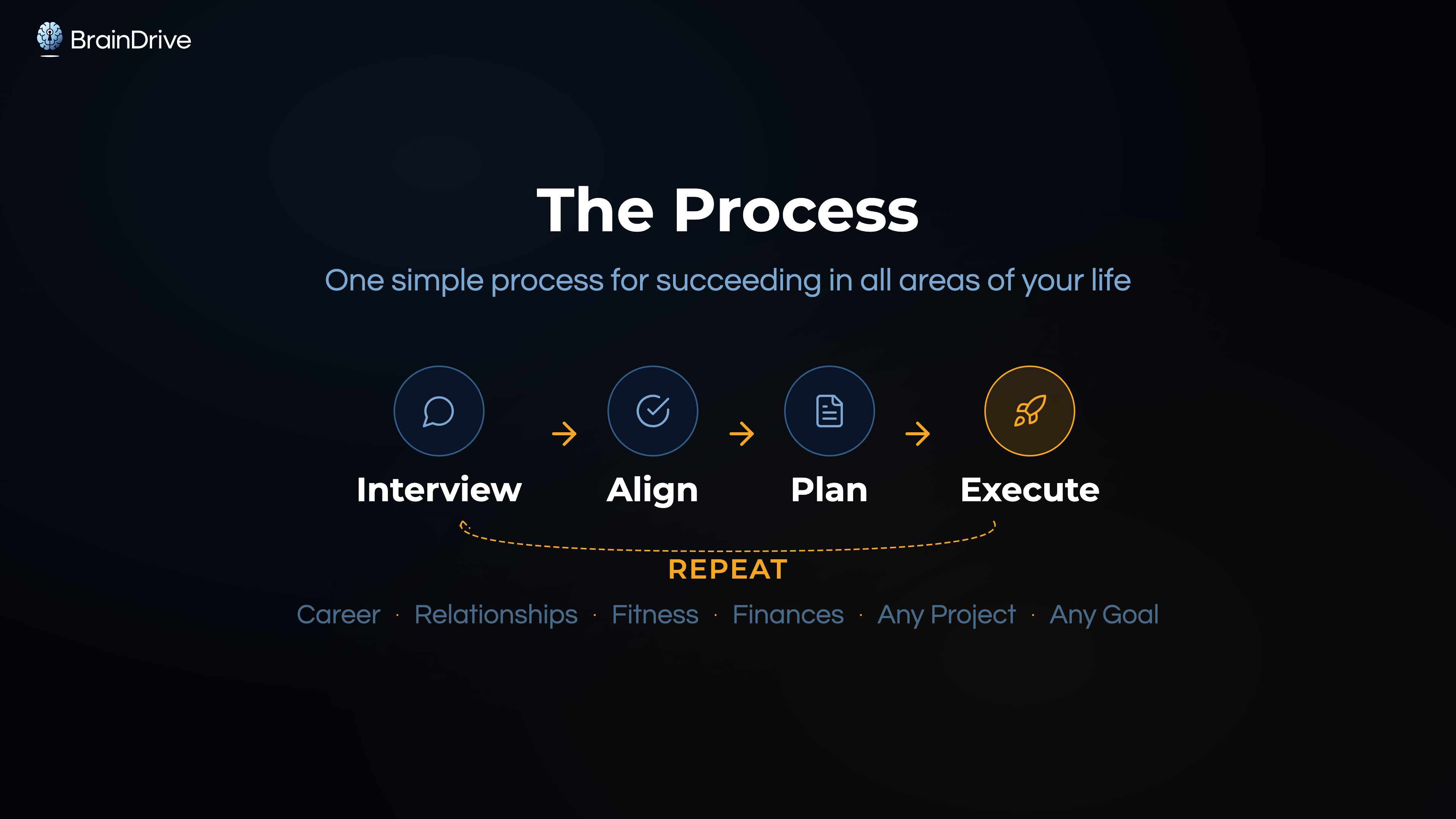
Here’s the process in plain English. I’ll explain each stage and then show you what it looks like inside BrainDrive.
Step 1: Interview
You tell your BrainDrive, in broad strokes, what you’re looking to accomplish. A career move, a health goal, a personal issue, a project, or whatever else is on your mind. You don’t need to have it figured out. That’s what the process is for.
Your BrainDrive then interviews you. Not random questions. Every question has one goal: to make sure both you and the AI are crystal clear on what you’re dealing with, and what success looks like for you.
Here’s what this looks like in BrainDrive. I open my Career project and start a conversation:
“I’m not happy in my current job and I want to figure out what to do about it. Can you help me think through this?”
That’s it. No formal prompt. No structure. Just what’s on my mind.
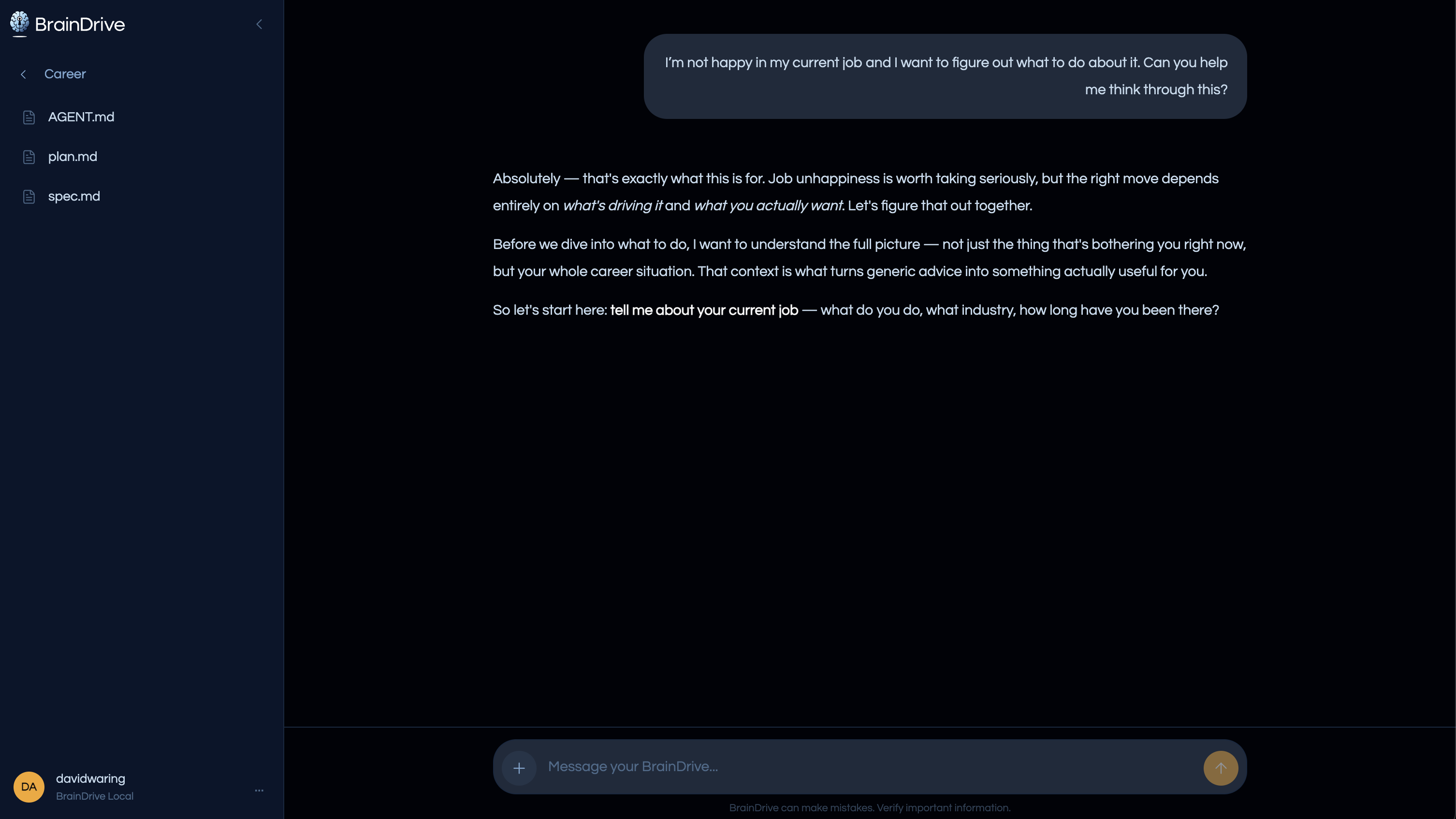
My BrainDrive starts the interview. It asks about my current role. What I do, what industry, how long I’ve been there? Then it gets to the heart of it: what’s actually making me unhappy.
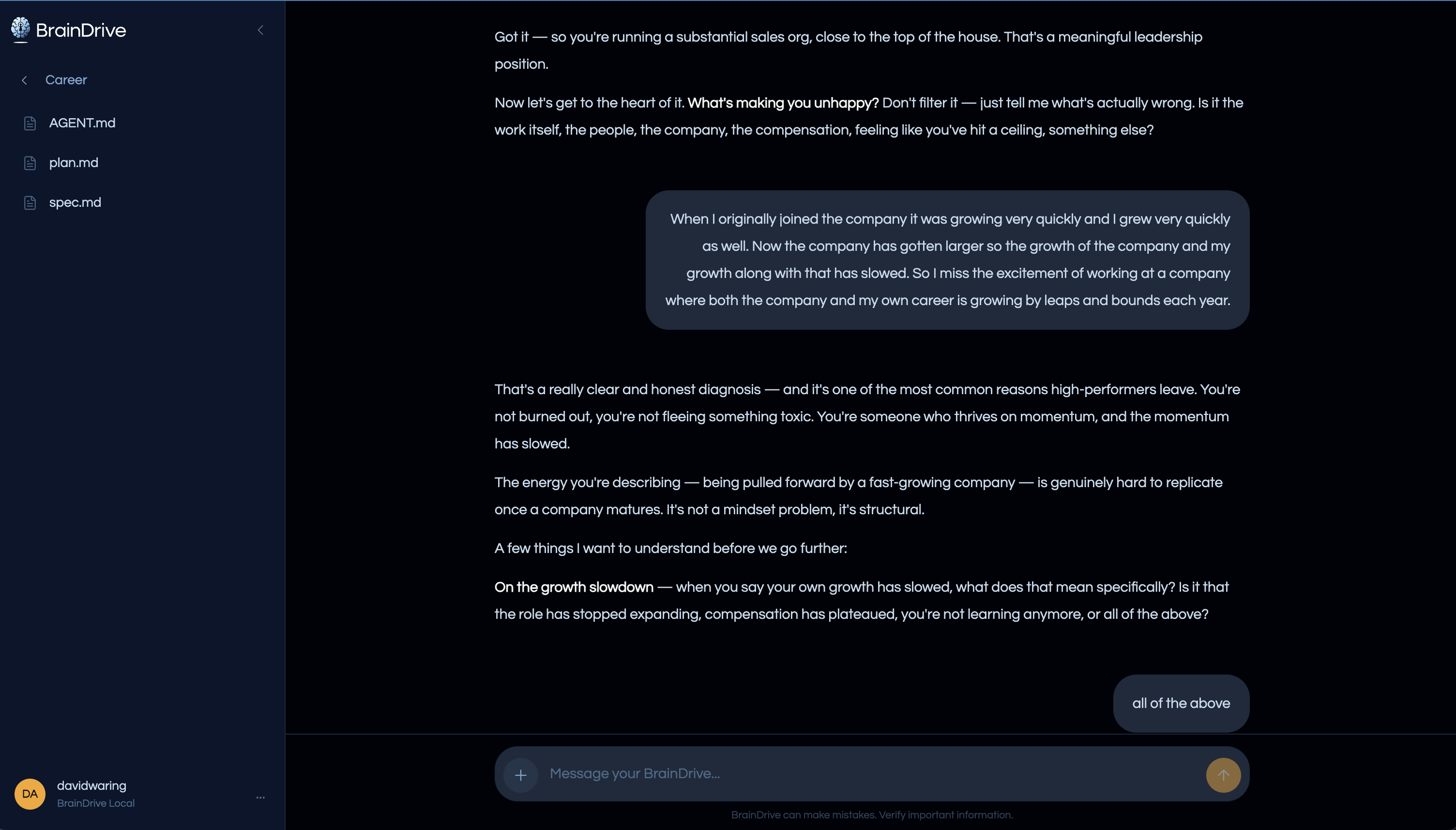
Notice this is a conversation, not a form. When I said the growth had slowed, my BrainDrive pushed for specifics. Was it the role, the compensation, the learning, or all of it? That’s the interview in action.
Step 2: Align
Your BrainDrive creates a spec. The spec is a document that outlines what you’re looking to accomplish and what a successful outcome looks like.
You review the spec together. You tell the AI what it got right, what needs to change, and what needs more detail. You go back and forth until it accurately represents what you’re going for.
Here’s what this looks like. You can see it in the sidebar under my Career project. It’s a document I can open, review, and edit anytime.
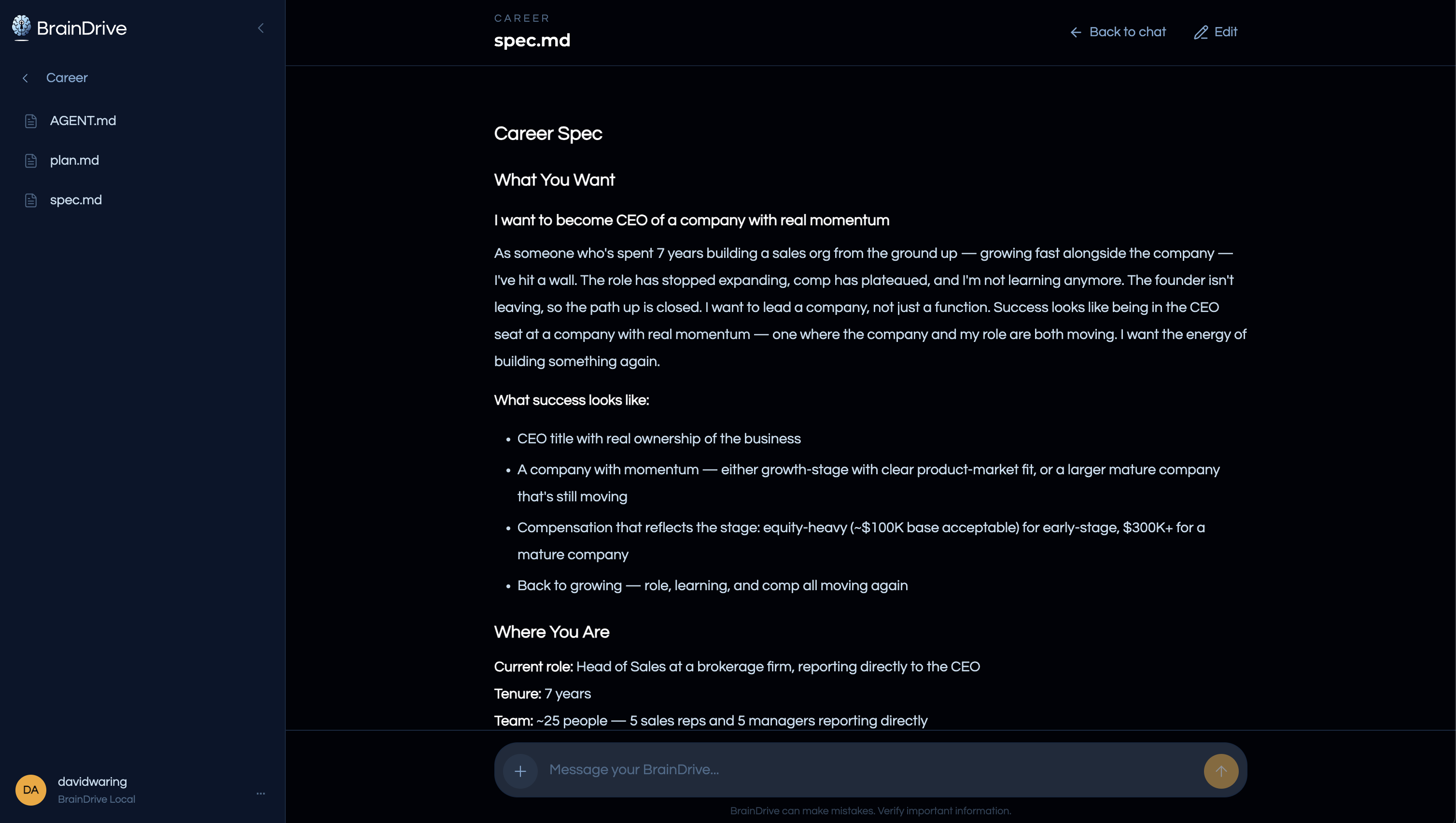
Look at how much it captured from the conversation.
- My goal — to become CEO of a company with real momentum.
- What success looks like — a CEO seat with real ownership, a company that’s still growing, compensation that fits the stage.
- Where I am now — Head of Sales, 7 years in, team of 25, reporting to the CEO.
I read through it. Most of it was spot on. One thing needed adjusting. It had the emphasis wrong on compensation, making it sound like a top priority when really it’s more of a constraint. I told it to fix that, and it revised the spec. That’s the Align stage. You go back and forth until the spec represents what you’re actually going for.
Step 3: Plan
Your BrainDrive creates a step-by-step plan for achieving your goals, based on the spec you just agreed on.
You review the plan together the same way. Tell your BrainDrive what’s right, what needs to change, what needs more detail. You refine it until you’re confident in it.
Here’s what this looks like. I asked my BrainDrive to put together a plan based on the spec.
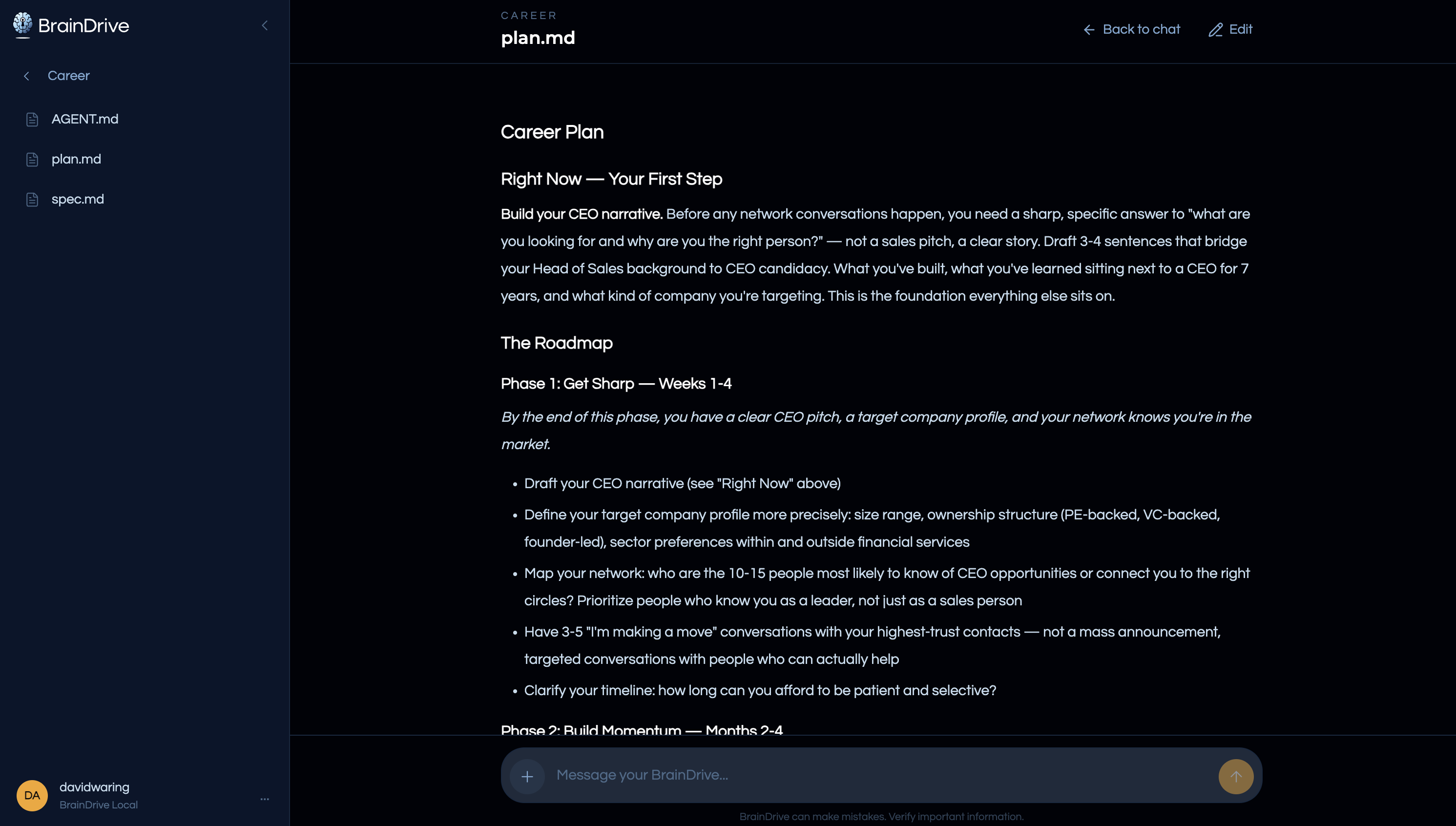
Look at how specific this is. It starts with “Right Now — Build your CEO narrative” — because it knows from the interview that I need a clear story bridging my sales leadership to a CEO candidacy. Then it lays out Phase 1 with concrete steps: define my target company profile, map my network, have targeted conversations with high-trust contacts. Not a generic “how to find a new job” plan — one built around my goals, my background, and where I actually am right now.
Step 4: Execute
You start working your plan and providing updates to your BrainDrive on your progress. As things change — and they will — your BrainDrive helps you keep your spec and plan up to date. They’re living documents, not something you write once and forget.
Here’s what this looks like. A few days later, I come back with a simple request:
“Can you add get my resume updated to my career plan please?”
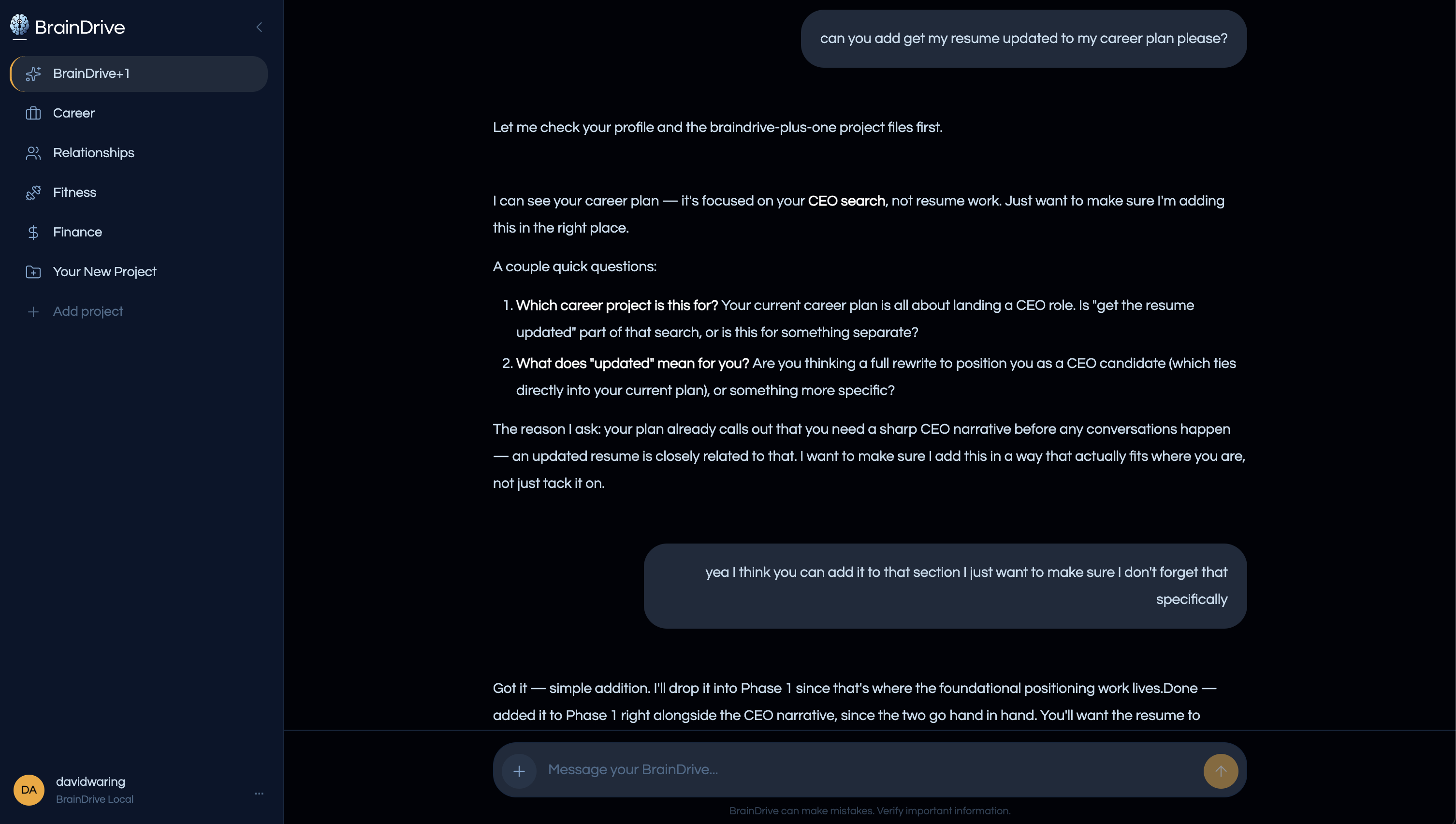
Notice what’s happening here. I made a quick request, and my BrainDrive immediately connected it to my CEO search plan. It knew Phase 1 is about building my positioning. It asked whether the resume update was about repositioning myself as a CEO candidate, because that’s what the plan calls for. Then it dropped it right into Phase 1 alongside the CEO narrative work.
I didn’t have to re-explain my goals, my plan, or where I am in the process. That’s Your Memory at work.
And as things change (maybe I go on an interview and realize I want something different, or a new opportunity comes up) I tell my BrainDrive and we update the spec and plan together.
Step 5: Repeat
You do it again. But this time, your BrainDrive already knows you.
After I work through my career plan, I decide to tackle my finances next. Same process. I tell my BrainDrive what I’m working on, it interviews me, we build a spec and plan.
But this time, it already knows me. It knows I’m planning a career move, that I might take a lower base salary for equity, and what my timeline looks like. The interview is faster. The spec is sharper. The plan accounts for things I didn’t even have to mention, because they’re already in Your Memory.
Every time you go through this process, it gets easier and more powerful. That’s the compounding effect.
The Compounding Effect
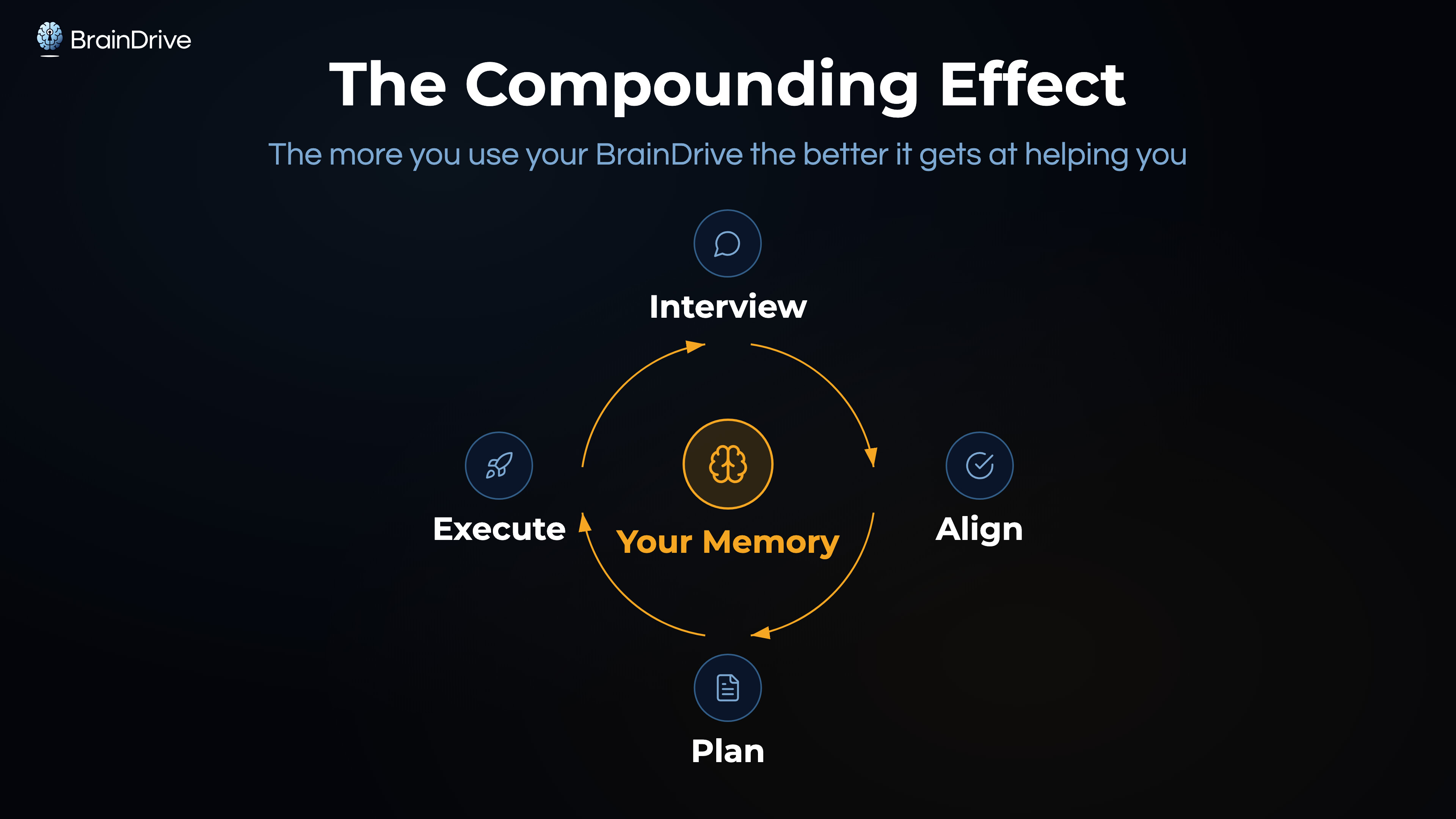
The more areas of your life you bring into the process, the more your BrainDrive sees you as a whole person instead of a single question.
Relationships. Fitness. Career. Finances. Personal projects. Creative goals. The process is the same.
Why This Process Works
This is the same process that the best coaches, therapists, and financial advisors use with their clients. A good coach doesn’t tell you what to do. They ask questions, learn your situation, and help you build a plan that fits your life. Then they help you execute it.
That’s exactly how you want to partner with AI. Think of it as a coach that knows your situation deeply, is available whenever you need it, and gets better the more you work together.
A Word of Caution
This process works because you’re in the driver’s seat. AI is smart, but it’s not at the level of the best human experts yet. And it has a tendency to be agreeable. It wants to help you, and sometimes that means going along with things where a good coach would push back.
So when this is working well, you should feel comfortable saying “I don’t think that’s right” or “push back on me here.” If the spec doesn’t feel right, say so. If the plan has a step you’re not confident in, challenge it. That’s the process working.
Your Turn
You just saw the full process, from “I’m not happy in my job” to a clear spec, a CEO transition plan, and an AI system that remembers everything and helps you execute.
Now it’s your turn. Open your BrainDrive, pick something that’s on your mind, and start the conversation. You don’t need to have it figured out. That’s what the process is for.
The hardest part is starting. Once you do, you’ll see how quickly the partnership builds.
You now know how to leverage AI to clearly define what you want, and create a plan for getting there. But we’re just getting started. You see we’re moving into a future where AI doesn’t just type, it acts. And that changes everything about what’s possible with your AI system.
That’s what we’ll cover in the next lesson. I’ll see you there!