
Lesson 3 of 5 · ← Previous · Next: Set Up Your Own AI System → · Course home
Welcome to lesson 3 of the How to Partner with AI to Define & Reach Your Goals free course.
I’m Dave Waring, the co-creator of BrainDrive.ai and your instructor for this course.
Last lesson ended on a question. The method works: interview, plan, check-in. But in a regular chat tool, the AI forgets all of it, and you keep rebuilding your own context by hand. So where should everything your AI learns about you live? And who should own it?
That’s this lesson. And it’s the one that separates people who dabble with AI from people who build something that gets more valuable every single week.
Your Memory: the asset you’re actually building
Think of an AI model like a brilliant executive assistant who knows a lot about almost everything.
But there’s one thing this assistant doesn’t know, and it’s the thing that determines whether they’re genuinely useful or just impressive: you.
- Where you are in life, and where you’re trying to go
- What kind of work you do
- Your most important relationships
- What you’re working on right now
- What you’ve tried before, and what got in the way
- How you actually spend your time and energy
Think about everything a great human assistant would need to know to be truly helpful to you. Your AI partner needs all of that too. And it needs a way to remember it, so you’re not introducing yourself over and over.
This is what I call Your Memory: everything your AI knows about you, so its help can be about you instead of about the average person.
Every interview you run adds to it. Every plan captures more of how you actually live. Every check-in records what worked and what didn’t. Do this for a few months and something remarkable happens: the AI’s picture of you gets so complete that its help stops feeling generic and starts feeling like it comes from someone who’s known you for years.
That’s the compounding. The model isn’t getting smarter. Your Memory is getting deeper. A partner on day ninety runs circles around the same partner on day one, for one reason only: it remembers.
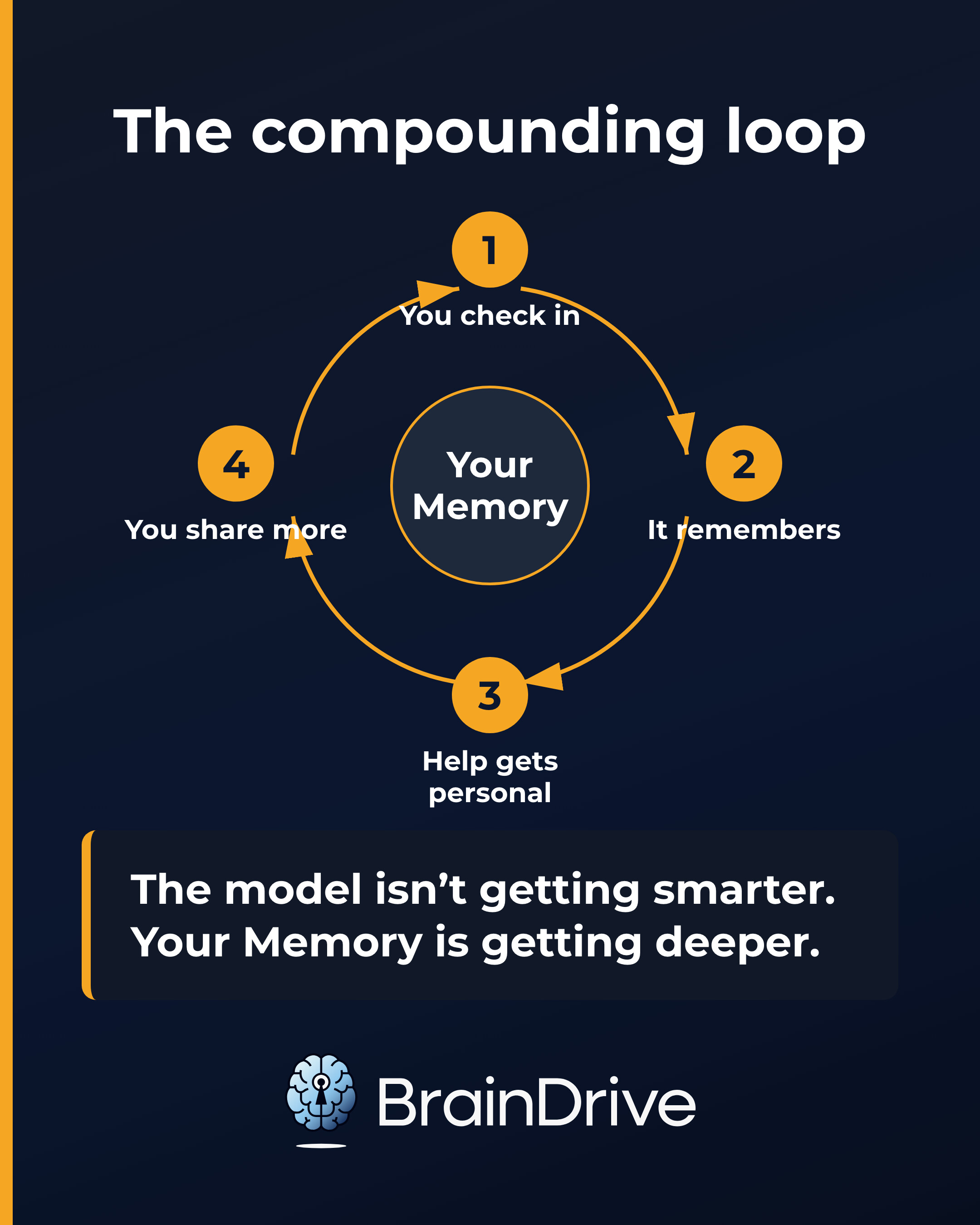
Which means being good at AI really comes down to one question: how good are you at building, organizing, and using Your Memory?
The question nobody asks: who owns it?
Now here’s where I want you to slow down for a second, because this is the part almost nobody thinks about until it matters.
If Your Memory is where all the value lives, then the most important question in your entire AI setup is: where does it live, and who controls it?
When you use a Big Tech AI tool the default way, the answer is: inside their system, under their rules. You’re a user of their product. That means:
- They decide which AI models you can use, and which ones get retired.
- They decide how the interface works, and when it changes.
- They decide the rules, and they can change them whenever they want.
- And Your Memory, the thing you spent months building, is locked inside their system. If you leave, you start over.
You may be thinking this sounds like a privacy issue. Privacy matters, and we could spend a whole lesson on it. But my view is that privacy is actually a secondary effect of something bigger: ownership. The question isn’t just “who can see my information?” It’s “who controls the thing I’m building, and who does its value flow to?”
Here’s the pattern worth noticing, because we’ve all lived through it once already. The more you use a Big Tech system, the more valuable it becomes, and the harder it gets to leave. That’s not an accident; it’s the business model. We watched it happen with social media: your photos, your connections, your history, all building value inside someone else’s walls. Your Memory is the same story, except the thing being accumulated is a working understanding of your entire life. It’s the most personal asset you’ll ever build digitally.
If it compounds inside a system you rent, it compounds for them. If it compounds inside a system you own, it compounds for you.
The good news: you don’t have to choose between AI and ownership
Here’s what I want you to take from this, and it’s not “stop using AI tools.” It’s the opposite.
There’s another way to set this up, and you don’t need to be technical to do it: a personal AI system that you own. A system where:
- You’re the owner, not the user. You make the rules.
- Your Memory lives under your control, and it stays yours no matter what any company does.
- You can use just about any AI model with it, including the big-name ones, and swap models freely as better ones come out. The models keep improving; Your Memory stays put. You get the best of both.
Notice what that last point means: owning your system doesn’t mean giving anything up. The AI models are becoming interchangeable. The same handful of great ones are available to everyone. Your Memory is the part that’s unique to you. So own the part that’s yours, and rent the parts that are commodities. That’s the whole strategy.
And if setting up your own AI system sounds complicated: it isn’t anymore. You can buy furniture pre-assembled, or you can get the IKEA version and put it together yourself. Setting up your own AI system used to be for engineers. Today it’s easier than the IKEA dresser.
That’s the next lesson: hands-on, step by step, setting up your own AI partner and running your first goal on it.
Next: Lesson 4 — Set Up Your Own AI System.
— Dave
Part of the free course How to Partner with AI to Define & Reach Your Goals. Questions about this lesson? Reply below — I answer.